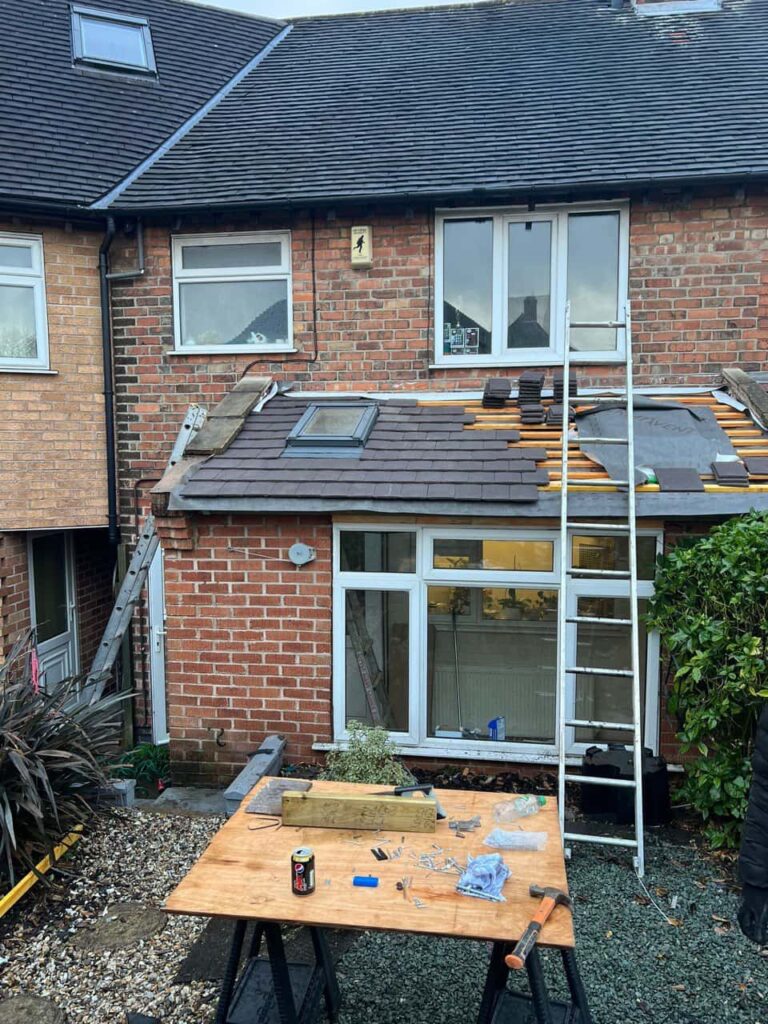
Concrete roof tiles are designed to form a durable, overlapping covering that protects the structure beneath from the weather. However, like every roofing material, individual tiles can become damaged or deteriorate over time. Cracking, breakages, slipping and surface changes may all become noticeable, but these signs do not necessarily mean that every tile on the roof needs replacing.
In many cases, isolated damaged concrete tiles can be replaced while the surrounding roof covering remains serviceable. The more important question is whether deterioration is confined to a few tiles or forms part of a wider problem involving multiple areas, fixings, battens, underlay or other roofing components.
For homeowners in Ringwood, Hampshire, recognising the difference between localised tile damage and more general roof deterioration can help ensure that roofing work remains proportionate. A professional assessment can establish what has failed, why it has happened and whether individual tile replacement is likely to provide an effective repair.
What Signs Indicate That Concrete Roof Tiles May Need Replacing?
Concrete roof tiles may need replacing when they are cracked, broken, badly displaced or otherwise unable to perform effectively as part of the roof covering. The condition of neighbouring tiles and the supporting roof components should also be considered.
One damaged tile can present a very different situation from repeated failures across several sections.
The objective should therefore be to identify whether individual tiles have reached the point where they should be replaced while also establishing whether there is an underlying reason for the deterioration.
Cracked Concrete Tiles Should Be Assessed
A visible crack is one of the clearest reasons to inspect a concrete roof tile.
Some cracks are obvious, while others can be relatively fine and difficult to identify from ground level.
The significance depends on the position and extent of the damage. A crack that compromises the tile can provide a potential route for water beneath the intended roof covering.
Replacing a genuinely damaged tile can restore the continuity of that section, provided the surrounding components remain in suitable condition.
Broken Tiles Usually Require Attention
Where part of a concrete tile has broken away, the affected area no longer provides the intended overlap and protection.
The missing section may expose underlying materials more directly to rainfall.
Impact, weather exposure or previous disturbance can all contribute to breakage.
A broken tile should not simply be viewed in isolation. Adjacent tiles should also be checked because whatever caused the original damage may have affected more than one component.
Missing Tiles Leave an Obvious Weak Point
A completely missing tile creates a visible interruption within the roof covering.
Materials beneath the tile can then become more directly exposed.
Replacing the missing tile is important, but understanding why it disappeared is equally worthwhile.
A failed fixing, broken nib or another weakness may have allowed the tile to move. If that cause is not considered, simply inserting another tile may not provide the most reliable repair.
Slipped Tiles Do Not Always Need Replacing
A slipped concrete tile is not necessarily a failed tile.
If the tile itself remains undamaged, it may be possible to reposition and secure it appropriately.
However, the reason it slipped needs to be identified.
Problems with fixings, tile nibs, battens or previous workmanship can all result in movement. Replacing a perfectly serviceable tile would not correct a deteriorated support or fixing beneath it.
Professional inspection helps distinguish between a damaged tile and a sound tile affected by another roofing defect.
Several Slipped Tiles Can Indicate a Wider Issue
One displaced tile may represent a localised defect.
Several slipped tiles concentrated within the same section deserve closer investigation.
A pattern of movement can suggest that the problem involves more than individual tiles. Supporting battens, fixings or another component within that section may require attention.
Repeatedly replacing or repositioning individual tiles without investigating why they continue moving can leave the underlying weakness unresolved.
Chipped Edges Should Be Considered in Context
Small chips do not automatically mean a concrete tile has stopped functioning.
The location and extent of the damage matter.
Minor surface damage can be very different from a break affecting an important overlapping section of the tile.
This is why concrete roof tiles should be assessed according to how the damage affects their function rather than appearance alone.
Surface Weathering Does Not Automatically Mean Tile Failure
Concrete roof tiles naturally change in appearance as they remain exposed to the weather.
Their surfaces can become more weathered, and the roof may no longer look as uniform as it did when first installed.
Appearance alone is not a reliable reason to replace otherwise serviceable tiles.
A weathered surface should be distinguished from physical defects such as cracking, significant breakage or deterioration that prevents the tile from functioning correctly.
The condition of the roof covering matters more than whether every tile still looks new.
Colour Changes Are Not Necessarily Structural Problems
Concrete tiles can undergo visible colour changes over time.
This can make an older roof look noticeably different from newer replacement tiles.
Colour variation does not automatically indicate that the tiles have lost their ability to perform as a roof covering.
When deciding whether tiles require replacement, greater attention should be given to cracking, movement, breakage, support and water resistance than cosmetic differences alone.
Moss Can Make Tile Condition Harder to Judge
Moss and other organic growth can develop on roof surfaces.
Heavy growth can obscure tile edges and make small cracks or defects more difficult to identify.
Its presence does not automatically mean that concrete tiles need replacing.
However, where substantial growth makes the condition of the covering difficult to assess, the underlying tiles may require closer inspection before conclusions are reached about their condition.
Repeated Water Ingress Can Point to a Roofing Defect
Internal damp or water staining can indicate that the roof requires attention, but it does not automatically prove that the concrete tiles themselves need replacing.
Water can enter through several parts of a roof.
A cracked tile may be responsible, but defects can also develop around flashing, valleys, ridges and other junctions.
The source should therefore be traced before tiles are replaced unnecessarily.
Accurate diagnosis is particularly important where previous tile replacements have not resolved recurring water ingress.
Water Can Travel Before It Becomes Visible
One reason roof leaks can be difficult to diagnose is that water does not always appear internally directly below the external defect.
Once moisture passes beneath the main covering, it can travel along roofing components before reaching a visible ceiling or wall.
This means the position of an internal stain should be treated as evidence of water ingress rather than a precise map of the external problem.
Professional inspection can trace likely water routes and assess the relevant roof areas.
Damaged Tile Nibs Can Cause Tiles to Move
Concrete tiles often rely partly on their formed profile and nibs to sit correctly against supporting battens.
If a nib becomes damaged, the tile may no longer remain positioned as intended.
The tile can then slip even when much of its visible surface appears intact.
In this situation, replacing the affected tile may be appropriate because the component responsible for supporting its position has become damaged.
Again, the surrounding area should be checked to establish whether the problem is isolated.
Fixing Problems Can Be Mistaken for Tile Failure
A tile can move because the method securing it has deteriorated rather than because the tile itself has failed.
This distinction matters.
Installing a new tile without correcting a fixing problem can result in continued movement.
Professional roof repairs should therefore consider how the tiles are being supported and secured rather than focusing exclusively on their visible surfaces.
Roof Battens Can Affect the Position of Concrete Tiles
Battens beneath the roof covering provide essential support for tiled roofing systems.
If a batten becomes deteriorated or damaged, the tiles relying on that section may no longer sit securely.
Several apparently problematic tiles can therefore share one underlying cause.
Where repeated slipping or uneven positioning occurs within a defined area, examining the supporting structure can provide a better explanation than assuming all the tiles have independently deteriorated.
Underlay Condition Can Also Be Relevant
The underlay beneath concrete roof tiles forms another important part of the roofing system.
Its condition is largely concealed from external view.
If water has repeatedly passed through defects in the main covering, underlying materials may have experienced prolonged exposure.
Replacing visible tiles can restore the outer covering, but where there has been repeated water ingress, the condition beneath the affected section may also need consideration.
Strong Winds Can Displace Vulnerable Tiles
Wind can expose existing weaknesses within a tiled roof.
A securely positioned tile should form part of a stable covering, but one with a weakened fixing or damaged support can be more susceptible to movement.
After periods of strong wind, displaced tiles should therefore be assessed for the reason they moved.
The event may have caused direct damage, or it may simply have revealed deterioration that was already developing.
Impact Damage Can Affect More Than One Tile
Falling debris or another impact can crack concrete roof tiles.
The most visibly damaged tile may not be the only one affected.
Neighbouring tiles can contain smaller cracks or may have been disturbed from their original positions.
Where impact damage is suspected, inspecting the surrounding section helps ensure that less obvious defects are not overlooked.
Previous Repairs Can Affect the Current Roof Condition
Older tiled roofs may contain replacement tiles from previous repair work.
This is not inherently a problem. Replacing damaged tiles is a normal way of maintaining a serviceable roof.
However, recurring repairs within the same area can indicate that the original cause has not been completely resolved.
If tiles continue cracking, slipping or becoming displaced in one section, it may be worth investigating the supporting components rather than continuing to replace individual tiles.
One Damaged Tile Does Not Mean the Whole Roof Is Failing
Homeowners can understandably become concerned when they notice a broken or missing concrete roof tile.
However, isolated damage does not automatically indicate widespread roof deterioration.
If surrounding tiles, fixings and supporting materials remain in suitable condition, replacing one or a small number of damaged tiles may be all that is required.
This is one of the reasons assessment is valuable. It allows the extent of the problem to determine the repair rather than assuming that visible damage is more widespread than it actually is.
When Do Multiple Damaged Tiles Become More Significant?
The pattern of deterioration can be more informative than the condition of one individual tile.
If damaged tiles are appearing across several unrelated areas, or new problems continue developing after previous repairs, the wider roof should be assessed.
Signs that may justify broader investigation include:
- Numerous cracked or broken concrete tiles
- Repeated slipping within several sections
- Multiple previous tile repairs
- Recurring water ingress
- Uneven tile courses
- Widespread movement
- Problems affecting both tiles and supporting components
- Several areas deteriorating within a relatively short period
These signs do not automatically mean every tile needs replacing. They indicate that treating each defect independently may no longer provide a complete understanding of the roof’s condition.
Should All Older Concrete Tiles Be Replaced?
Age alone should not be the only deciding factor.
Two roofs of a similar age can be in very different condition depending on their construction, exposure, maintenance history and previous repairs.
Older concrete tiles that remain intact, stable and properly supported may continue to perform their intended function.
Conversely, a roof experiencing repeated failures deserves investigation regardless of its age.
The actual condition of the materials should therefore guide the decision.
Can Individual Concrete Roof Tiles Be Replaced?
Yes, individual concrete roof tiles can often be replaced where deterioration is localised.
The damaged tile can be removed and a suitable replacement incorporated into the existing covering, provided the surrounding construction allows this to be done appropriately.
This targeted approach preserves serviceable roofing materials.
However, individual replacement is most effective when the reason for the damage is understood and there is no broader defect requiring attention.
Replacement Tiles Need to Integrate Correctly
A replacement concrete tile needs to work with the surrounding roof covering.
Its profile and positioning should maintain the correct overlap and alignment with neighbouring tiles.
Simply filling an empty space with a tile that does not sit appropriately can introduce new weaknesses.
Professional repair considers how the replacement integrates with the existing tiled system rather than treating it as a separate component.
When Might More Extensive Tile Replacement Be Appropriate?
More extensive work may be considered where deterioration affects a substantial section rather than a few isolated tiles.
For example, widespread cracking, repeated tile movement or deterioration combined with problems beneath the covering may require a broader repair approach.
The decision should be based on evidence from the roof itself.
Replacing a large area unnecessarily is not appropriate when the problem is genuinely localised, but repeated small repairs may also become ineffective if they are addressing symptoms of more general deterioration.
Why the Complete Roof System Should Be Considered
Concrete tiles are only the visible outer layer of a tiled roof.
Their performance depends on several connected components, including:
- Tile condition
- Correct overlaps
- Fixings
- Battens
- Underlay
- Ridge details
- Valleys
- Flashing
- Roof junctions
A problem involving any of these areas can sometimes appear to be a tile defect.
Assessing the complete system helps ensure that replacement tiles are installed where they are genuinely needed and that other causes are not overlooked.
Early Attention Can Help Keep Repairs Localised
A small roofing defect is often easier to address while the surrounding materials remain sound.
Replacing a cracked or broken tile before prolonged water exposure affects the area underneath can help keep the repair focused.
Similarly, correcting the reason a tile has slipped can prevent repeated movement.
Early attention is therefore useful not because every minor visual change requires immediate major work, but because genuine defects can be investigated before they have the opportunity to affect connected roofing components.
Why Professional Roof Assessment Matters
Deciding whether concrete roof tiles require replacement involves more than looking for differences in colour or surface appearance.
The important questions are whether the tile remains structurally intact, whether it is correctly positioned, whether its support is sound and whether the surrounding roof is performing properly.
Professional assessment can distinguish between cosmetic weathering, isolated tile damage and wider deterioration.
This allows repair work to focus on the actual cause while retaining sound roofing materials wherever appropriate.
Concrete Roof Tile Repairs in Ringwood, Hampshire
At MCM Roofing Repairs Ringwood, we assess concrete tiled roofs with attention to both visible tile damage and the condition of the surrounding roofing system.
Where tiles are cracked, broken, missing or slipping, the affected area can be examined to determine whether individual tile replacement is appropriate or whether another component is contributing to the problem.
For homeowners in Ringwood, Hampshire, this approach helps ensure that repairs are based on the actual condition of the roof rather than replacing serviceable tiles unnecessarily.
Conclusion
Concrete roof tiles may need replacing when they are cracked, broken, missing or damaged to the extent that they can no longer perform correctly within the roof covering. However, slipped tiles, surface weathering, colour changes and isolated visual deterioration do not automatically mean replacement is required.
The wider pattern is equally important. One damaged tile may need a straightforward local repair, while repeated failures across several areas can indicate issues involving fixings, battens, underlay or other roofing components.
If you have noticed cracked, broken, slipped or missing concrete roof tiles at your property in Ringwood, Hampshire, contact MCM Roofing Repairs Ringwood to arrange a professional assessment. We can identify the extent and likely cause of the deterioration and determine whether individual tile replacement or a broader repair is the appropriate approach.
Call us on: 01425 208 596
Click here to find out more about MCM Roofing Repairs Ringwood
Click here to complete our contact form and see how we can help with your roofing needs.